

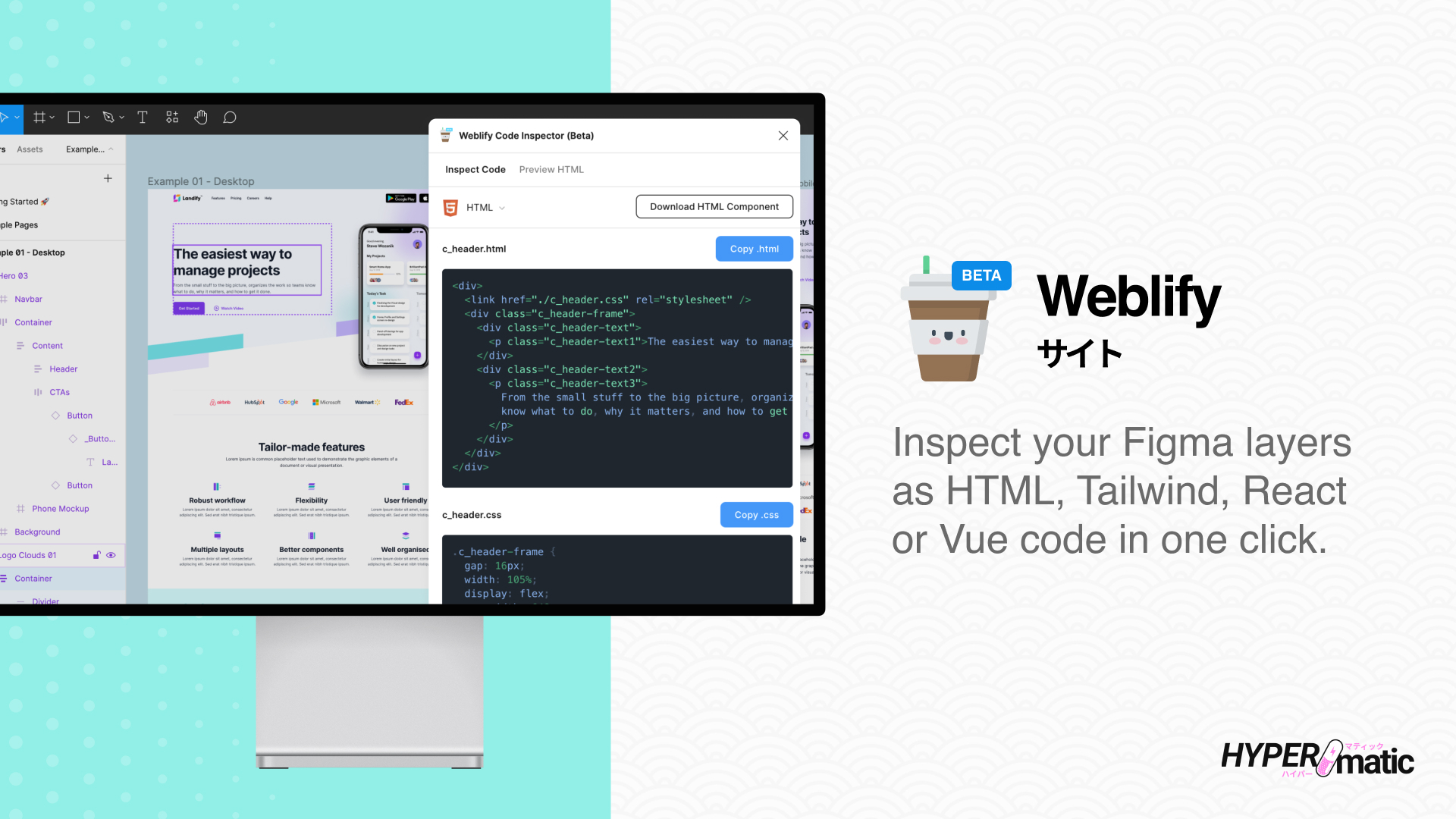
Installing the Weblify Figma Plugin
- Open any Figma file.
- Click on the Actions icon in the bottom Figma toolbar.
- Click the Plugins & Widgets tab to filter results to Figma plugins.
- Search for Weblify in the search bar.
- Click on the Weblify search result.
- Click the Save button to install the Weblify plugin.
Figma users in a Figma Organization may only be able to install approved plugins. Please contact your Figma Org admin at your company to approve the Weblify plugin if you're unable to install certain Figma plugins.
Running the Weblify Figma Plugin
Once you've installed the Weblify Figma plugin, to run the plugin in your Figma file:
- Right-click anywhere on your Figma file's page canvas
- Hover your mouse over the Plugins ▶ menu item
- Hover your mouse over the Saved plugins ▶ menu item
- Click on the Weblify plugin menu item
After you've run the Weblify plugin once in a Figma file, you'll be able to quickly re-launch it by clicking the Weblify icon in the right-hand side Figma column (under the Plugin subheading).
Only Figma users with Edit access to a Figma file can run a Figma plugin in that Figma file; if you only have View permissions, you won't be able to run any Figma plugins in that file.
Install and activate Weblify
Install & Run the Figma plugin
How to run Weblify inside of Figma
Activate Weblify Pro
How to buy and use a Pro license key
Using Weblify
Build a Website
Create editable website pages from templates, sections, and elements
Import a Website
Copy a page or selected element with the free Chrome extension
Audit & Export
Validate and download a static HTML and CSS website
Inspect Figma Layers
Generate HTML, Tailwind, React, or Vue code from a selected layer
Frequently asked questions
Troubleshooting Weblify
Common issues you may run into
Weblify Security
Details about how Weblify works
Receipts
Find email receipts and PDF invoices
Billing
Manage your Pro subscription
License Seat Management
Manage the Figma users on your key
Weblify Free vs Pro
Compare Free vs Pro features
Weblify features
- Create editable website pages from templates, sections, elements, and responsive layouts.
- Copy public or logged-in websites into Figma with the free Chrome extension.
- Preview generated website output at different viewport widths.
- Audit and export Weblify pages as a static HTML and CSS website.
- Inspect selected Figma layers as HTML/CSS, Tailwind, React, or Vue code.
- Copy generated code or download a component ZIP with its image assets.
- Work with Figma auto layout, wrapping, and min/max layout properties.
- Use Weblify's code inspection tools from Figma Dev Mode.